
Presence Hence
A Short Take » On presence » Plus three exterior photos highlighting the Walker Sisters' cabin home

To walk into this home is to step into the profound.
The profound is a soliloquy of seven sisters, all of whom loved each others’ presences, all various yet sundry, to each other and the public; and six who lived with and represented each other until, in each and every unique instance, another would depart the earth which they would never yield to the National Park Service, until, one by one, they were at one. She then was the embodiment of all seven, and then she died, she living in this cabin still, in 1964. The last individual person to remain on her myriadal ancestral property.
She probably drew her last breath in the common room at the base of this ladder.
She did not leave behind emptiness.
If one has read of these sisters, it is hard to be in that room and not feel a small element of each sister’s presence and departure, for if they chose, or by care had to sleep in a bed there on the ground floor, or if they continued the communal arrangement in the loft area above, you are in a room surrounded by a vestigial whisper of each of their presences.
A sense of chorus. 𐄫 But as one.
I love the National Park Service. I love what they salvaged from the robber barons, who were leaving this region in wreck and ruin. Much as we are all experiencing today. I love that the NPS tried to be fair to the people they acquired their homes from, piece by piece, word by word, parcel by parcel, care for care, foot by linear foot, and I love all the more that these six women, these six sisters, the seventh of whom married one of the most accomplished Smoky Mountains photographers this region ever produced from these same lands, would never relinquish their presence from this land.
This one husband—making photographs which recorded their quiet protest by archiving their presence in situ; their lovingly unremitting dedication to their home. To their people, their neighbors.
In a recent post I saw, complete with an AI-enhanced full color photo of the last two surviving Walker sisters, it was stated that the sisters had “generously been allowed to remain on their family homeplace through a lease agreement with the NPS, and sell their wares to the tourists.” I’ve not quite yet chosen to explore who leased what to whom.
On entering this main room I’m inside a refrain and I’ve become a fermata.
Within this interior exists a representation of emptiness; of vacuity, but only for a moment if one allows their eyes and mind to accustom themselves to the rich and still living darkness which is suspended in Time. You must breathe deeply to partake of this place.
This home.
This safe haven, even in our current day, which, if on a quiet day, as this day was that cold November afternoon, slightly wet and threatening more rain, so that this cabin, dating as far as I can tell from 1840 to that day in November 2023, one hundred and eighty-three years later from its simple beginning, and fifty-nine years after the last Walker sister, Louisa, who died in 1964, her cabin still offering haven that day in 2023 as it always did the members of the Walker family, who bought the single one-room cabin in 1870, and had always enjoyed it’s history and its shelter.
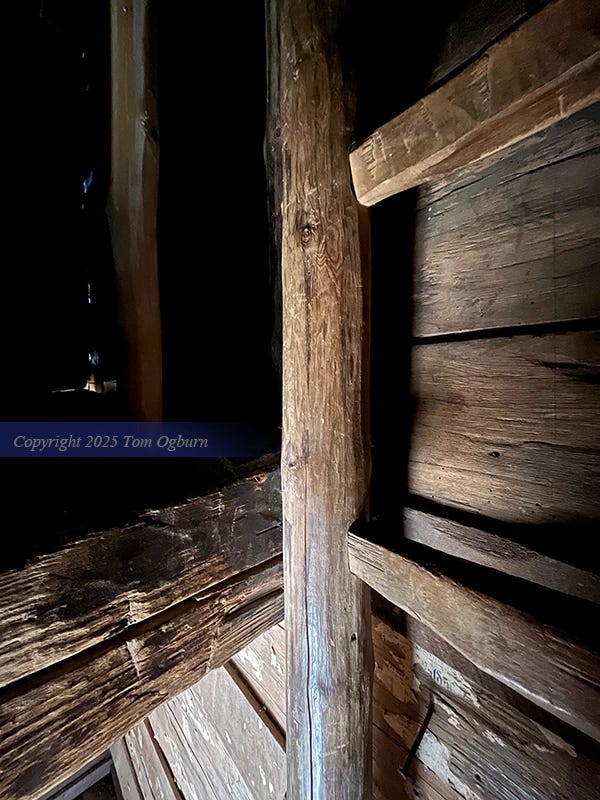
There is that living presence still within these walls, which I was so glad to see the NPS has left in its stark loveliness, employing in its emptiness the sheer essence of a powerful family presence, without the oh-so-often pastiche of recreated furnishings. There is very little interpretive signage; what is there is spare, but informative, and falls into tonalities of the greater surround. Again, the National Park Service operating at its best, using minimalism very well, thus striking an almost subsonic bass chord on a quiet stage. It’s there, but one needs to be aware of that quiet chord being there. Nearly eternal. Akin to one of our fallen’s eternal flame, just not immediately evident.
One becomes softly attuned the longer we remain in this space.
These spaces.
Its Spartan and regal starkness is a humane warmth that we rarely receive when visiting such places today. The more I consider this sublime sensibility of allowing minimalism to represent the sisters’ presence (and thus their absence) the more I realize by imagination only that I am experiencing something much older than I have ever felt when visiting the dwellings of our older European ancestors, who left upon their arrival in America, from the crowded port towns of the Carolinas, Virginia, and Georgia, to strike out into the outback regions of the Southeast. Especially those Southern Appalachian-bound earliest white homesteaders who assimilated deeply into the over-mountain indigenous population in the late 1600’s. In the very, very pre-Colonial era.
The 17th century Melungeons and Turks, often said to have aligned with the indigenous Lumbee or the Catawba and Cherokee of the Taxahaws (the upper backcountry of both South and North Carolina) as early as 1645, may be the earliest Turk and North African/Mediterranean settlers predating the settling of Charleston, South Carolina. Those who left immediately to retire into the over-mountain region of then North Carolina, now Eastern Tennessee. Many of the Southern Appalachian families have evidenced genetic ties to these early Melungeon/Turk peoples.
The Walker Home feels, seems, and radiates what I imagine I will feel one day when I finally see Europe, when I visit ancient ruins with both horizontal and vertical surfaces polished by generations of hands and feet, paws and possibly hooves. It radiates that patina, the soft sheen of living beings’ constancy of use.
For this is one such place. So much of those same axial surfaces so enhanced by the touch of human and animals. So polished by the fact that they were here, and that no one, not even the machinations of the wildly successful usually good-hearted FDR social programs, yet not forgetting the Japanese/American concentration camps his same administration approved during World War II just a few year later. It was however FDR’s great social programs which ushered in the end of the Robber Barons wake of destruction, depletion of lands and natural resources. We all stumble, but for the most part FDR’s administration was able to deliver positive change and support for many people struggling to survive the pre-war years. As powerful as the federal government became during this era, even as nearly all private lands became part of the public lands of the National Parks and United States Forest Service, the Seven Sisters land remained distinctly unique.
Their home exists as a monument to far more than the human equations that lived and cohabited the deep Smokies insularities, the tiny galaxies existing in the gorges and hollows of places receiving the Sun’s light only a few hours of each afternoon, for all those inhabitants’ tenure as settlers, homesteaders, and communities.
Most such isolated places exist no more, not in my experience, at least in my last 65 years of visiting where such places are still celebrated, recorded in interpretative signage illustrating the way they looked long ago, photographed by young CCC trained photographers, then drafted for service along the Parks and Parkways as well crafted visual stories and historical reference. At times accompanied by original buildings or features cared for within the various Parks Systems, whether Federal or State owned. This has been the way of things since the National Parks Service inception.
It is a Paean to those who seek the Walker Cabin, to experience it still in its pure form—and to the Walker family, who never really left it at all, thankfully, but over time, granted us their dreams, their memories and solitude.
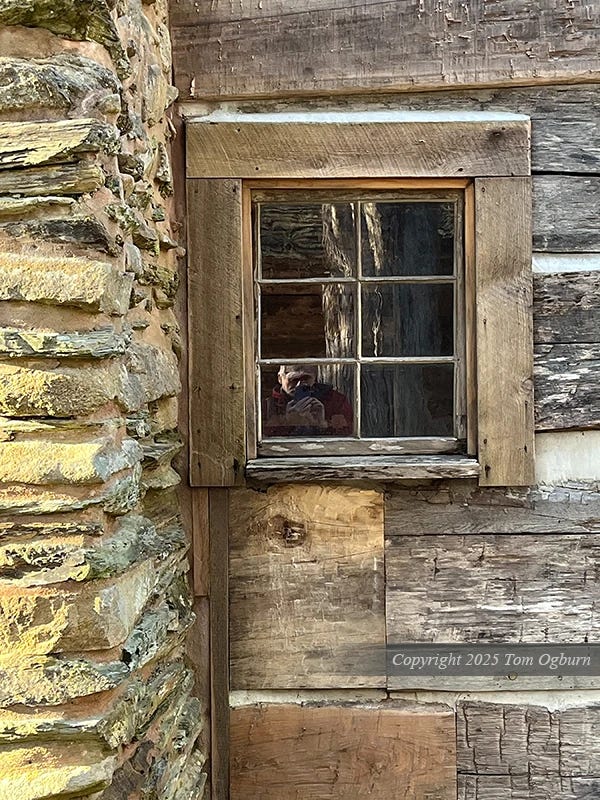
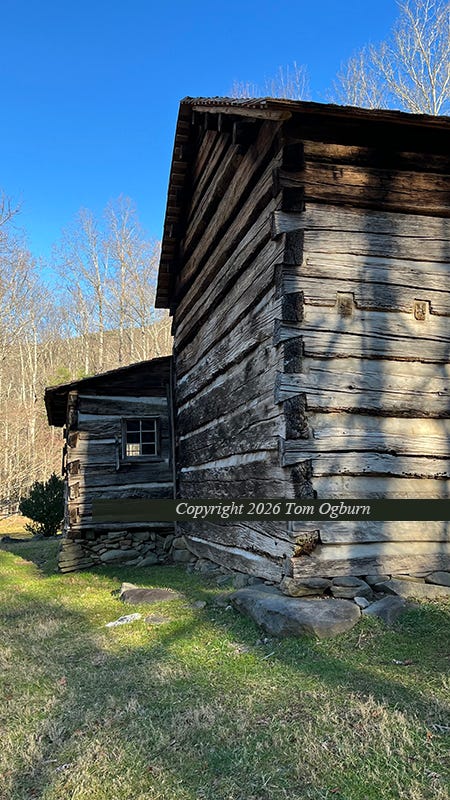
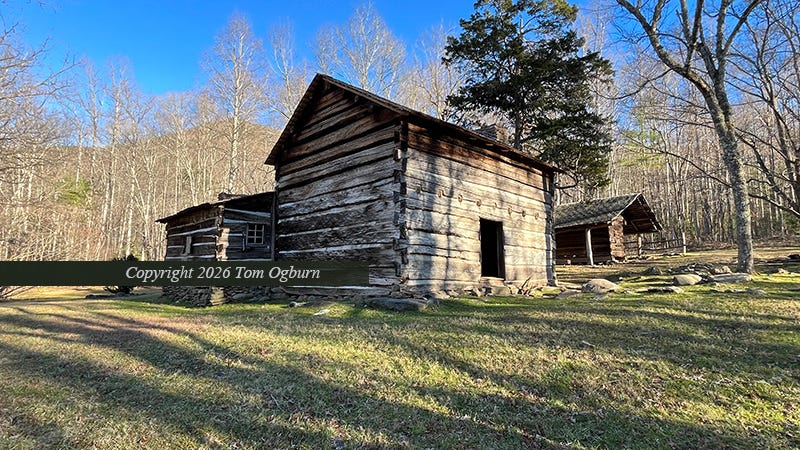
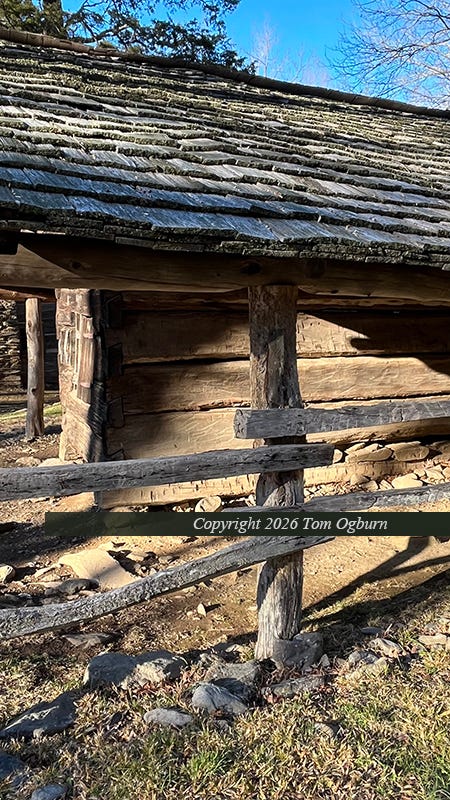
Three exterior views of the Walker cabin and the corn crib just back of the home. These photos illustrate the care of preservation efforts of The Great Smoky Mountain National Park, which stands in counterpoise to the way the Blue Ridge Parkway historic buildings are being allowed to deteriorate by willful neglect of current administrators placed into their positions in 2016, and sadly never removed. Theirs seems not to be a custodial management procedure, but one of measured edict and decree.
This differential will be one of the twelve tier topics of The Parkways Projects as it develops. I’m hoping to get back up there to photographically chronicle whether the unecessary deterioration I saw so evidently employed in 2019, and again in 2003, is still in effect. Especially after the widespread devastation of Hurricane Helene in late September 2024, followed by the lack of the United States Government support to aid the entire region, and failure to help the Southern Appalachian region to recuperate fully to this day.
Amazing
How old is the home